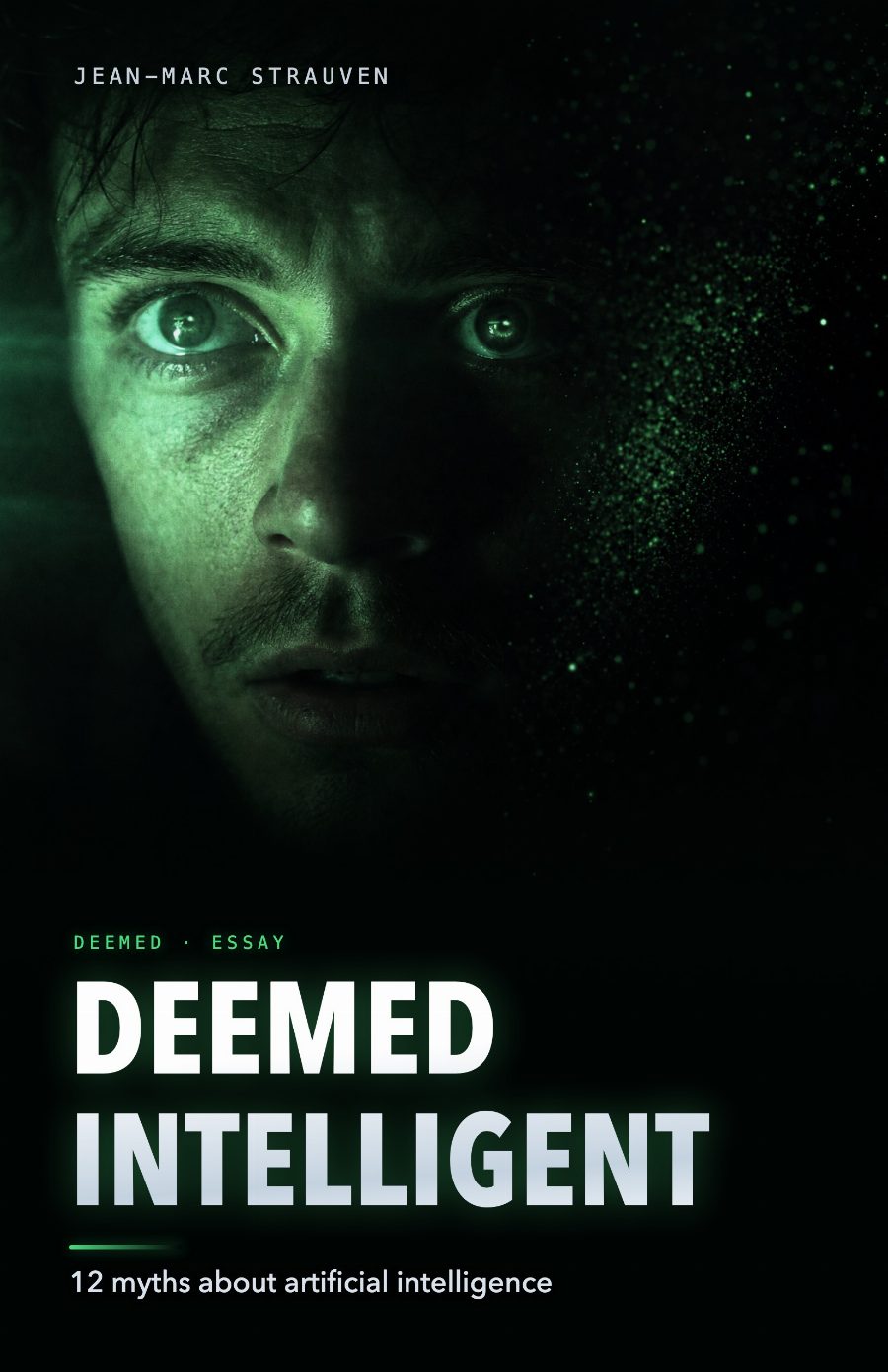
Deemed Intelligent
Essay
Édition anglaise de Réputée intelligente.
Lire l'ebook · 5,49 € sur bol.com Toutes les options : boutiques et formats ↓
A machine writes your emails. A boss swears it will replace his teams. A president restarts a nuclear plant to feed it. And nowhere, it seems, has anyone actually checked what it can do.
Twelve myths. Twelve takedowns, backed by dated facts.
The machine-breakers of 1811, and the queen who had already worked it out in 1589. The lawyer with the invented case law. The agent that wipes a database, then apologizes — self-rated severity: 95%. The 95% of corporate AI projects with no measurable effect at all. Three Mile Island, rebranded “clean energy.”
Weaving together the history of technology, verified data, and the ordinary lives these stories upend — a lawyer on a train, the owner of a small business staring at her invoices for intelligence, a grandmother at the end of a phone line — this essay reads like a novel and dismantles, one by one, the great narratives of our time: the replacement of human beings, “this time is different,” the global race, shared progress, the machine that knows.
Artificial intelligence creates almost nothing of what it is credited with: it reveals and amplifies what was already there — our costs to cut, our credulities, our surrenders. This book speaks of it. Above all, it speaks of us.
Written with the assistance of an artificial intelligence — verified, chosen and owned by the author: the method is explained in the foreword.
La bande-annonce
Où le lire
- Amazon Kindle 5,99 €
- Amazon broché 15,99 €
- Gumroad EPUB 5,99 €
- Google Play EPUB 6,02 €
- bol.com EPUB 5,49 €
- bol.com broché 19,00 €
- Books2Read EPUB 5,99 €
Le lien Books2Read mène aussi à l'ebook chez Kobo, Apple Books, Barnes & Noble, Tolino, Vivlio, Smashwords, Everand, Fable et Bookshop.org, et il est proposé aux bibliothèques via OverDrive, cloudLibrary, BorrowBox, Hoopla, Vivlio Libraries.
Les premières pages
Try the experiment for a week. Every time you come across the words "artificial intelligence", write down what you are being told about it. Monday, the evening news: it is going to wipe out half of all jobs. Tuesday, an advertisement: it is going to unleash your creativity. Wednesday, a worried expert: it threatens democracy. Thursday, a government minister: it is the key to our sovereignty, we must invest. Friday, your employer: it is at the heart of the strategy, mandatory training awaits you. Saturday, a dinner party: your brother-in-law has bet everything on it, your niece no longer hands in homework without it, and someone ends up sighing that there is nothing to be done about it anyway. Sunday, you are tired — and you still have no answer to the only question that matters: what can this machine actually do, and what exactly are we being told? This book was born of that particular fatigue. Not of the technology — it is what it is: often astonishing, sometimes disappointing, always more ordinary than its posters — but of the noise that surrounds it: that din of promises and panics in which the same unverifiable figures pass from mouth to mouth, in which prophets of apocalypse and vendors of miracles share the television studios, and in which the honest citizen, ordered to tremble in the morning and marvel in the evening, ends up giving up on understanding altogether. That surrender is no small detail: a society that no longer understands what is being installed in its midst can no longer demand anything, negotiate anything, choose anything. The noise is not an accident of our times. It is, as we shall see, their instrument.
So how does one take a myth apart? This book goes about it with three tools, always the same ones, chapter after chapter — we may as well announce them now; they are simple. History, first. It is the most powerful tool of the three, and the most neglected. Almost everything you are being told today about artificial intelligence has been told before — word for word, at times — about other machines: the weaving loom, the railways, electricity, the computer, robots. The same promises of paradise, the same announcements of replacement, the same bubbles, the same fears. And those stories possess a virtue that no debate about the future will ever have: they are over. We know how they end. We can compare what was promised with what came to pass, count the prophecies kept and the ruins left behind. When a queen of England refuses, at the end of the sixteenth century, to grant a patent in order to protect the livelihood of her knitters; when Victorian savers pour their life savings into imaginary railways; when a memorandum signed by, among others, a Nobel laureate and a future Nobel laureate announces the end of work in 1964 — those archives are test benches: they let us try today's claims against cases whose verdict is already in. This book returns to them constantly — not out of nostalgia, but as a matter of method. Data, next. Every factual claim in this book — every figure, every date, every quotation — has been verified and is sourced at the end of the volume. This is not academic vanity: it is the heart of the contract. For the myths of artificial intelligence live precisely on floating numbers — the "300 million jobs", the "47% of jobs at risk of automation" — repeated until they become true by sheer force of familiarity, and which almost no one ever reads at the source. This book takes them back there, systematically. You will find the exercise holds surprises: the most frightening figures often say something other than what they are made to say, and the most solid ones — those that measure what the machine actually accomplishes in companies, in code, in brains — are precisely the ones never quoted on air. The facts are dated in the text, because on a subject that shifts every quarter, an undated figure is already a rumor. Stories, finally — for this book holds a conviction about form: you do not dismantle a myth with briefing notes. A myth is a story; it can only be fought with better stories, truer ones. In these pages you will therefore meet people. Real people, with their names and their dates — a New York lawyer betrayed by an over-confident assistant, a swindler in a silicone mask, a Nottinghamshire clergyman, novelist sisters burned by a bubble — and even a king of Egypt whom Plato may well have invented, which is fair play; and imagined people, declared as such right here and recapitulated at the end of the volume, who carry the daily life of everyone — a company lawyer on a train, an employee staring at a "transformation" e-mail, the owner of a small business staring at her invoices, a grandmother at the other end of the line. The latter are fictional but not decorative: each embodies a situation that millions of people are living through at this very moment, and that statistical averages crush. The essay that follows reads, I hope, like a novel. That is deliberate. It is even, to my mind, the only courtesy owed to a reader one claims to be arming rather than lulling to sleep.
Three tools, then, and a title that needs explaining, because it carries the book's thesis. "Deemed", in law, is a terrible word: it means held to be such, whatever the reality. A thing deemed compliant is compliant in the eyes of the register, even when the real world screams otherwise. I have explored that word before, in a novel; I return to it here because it describes exactly our collective situation before the machine: artificial intelligence is deemed intelligent — by press releases, strategic plans, headlines, conversations — regardless of what it can actually do, which is at once considerable and far narrower than proclaimed. This entire book lives in the gap between the register and the real: twelve chapters, twelve statements that everyone repeats — it will replace us, this time it's different, it is already destroying jobs, it knows, it is immaterial, humans are obsolete… — and twelve dismantlings, piece by piece, with the three tools just described. Three points of honesty, before we enter. The first: this book is not against artificial intelligence. It makes use of it, it describes its real uses — including what is at times admirable in them — and every chapter contains its "grain of truth": what the myth under examination has of substance, for no myth prospers on nothing. This book is against the narratives: against the use being made of this technology to push through decisions, invoices and surrenders that owe it nothing. The second: it will not tell you what tomorrow holds. Nobody knows, and the first lesson of the archives is that those who claim to know are selling something. It offers something more modest, and more useful: the means to sort through whatever you will be told tomorrow morning. The third point is the most delicate, and this book would forfeit the right to keep it quiet: it was written with the help of an artificial intelligence. The research was dug through with it, the drafts rough-hewn by it, entire pages proposed by it — then every fact was verified, every figure traced back to its source, every scene argued over, every sentence reread, kept, corrected or thrown away by a human who signs this book and answers for it. I could have hidden that; it would have meant adding a thirteenth myth to the twelve I take apart. I prefer to see it as a demonstration, in action, of what these pages defend: the machine is a prodigious rough draft, and this book exists only through what it will never do — choosing what one thinks, verifying what one asserts, standing behind what one publishes. What you hold is therefore an object consistent with its own thesis: industrial plausibility, passed through the sieve of artisanal doubt. And should a passage prove false, do not blame the tool: the fault is mine, entirely — that, as you will see over the course of the chapters, is the whole difference between the two of us. For here, finally, is the thread that runs from one end of these pages to the other, and that each chapter will knot in its own way: artificial intelligence creates almost nothing of what is attributed to it. The fears it inspires, the powers it concentrates, the laziness it installs, the costs it serves to cut — all of it was already there, before it, in us. It reveals, it accelerates, it amplifies: it is a magnifying mirror trained on our economies, our institutions and our habits, and what we discover in it does not speak of the machine. This book speaks of the machine, since it must. Above all it speaks of us — and that, at bottom, is why it was written: because you cannot negotiate with a myth, but you can always negotiate with humans, provided you know what they are doing. Enjoy the read — and do not forget to check my sources. It would be the height of irony, in this book of all books, if you took my word for it.
La suite dans le livre.
Le prochain livre
Un mail quand il sort, parfois une promotion, jamais plus.